
The Betrayal of Children
By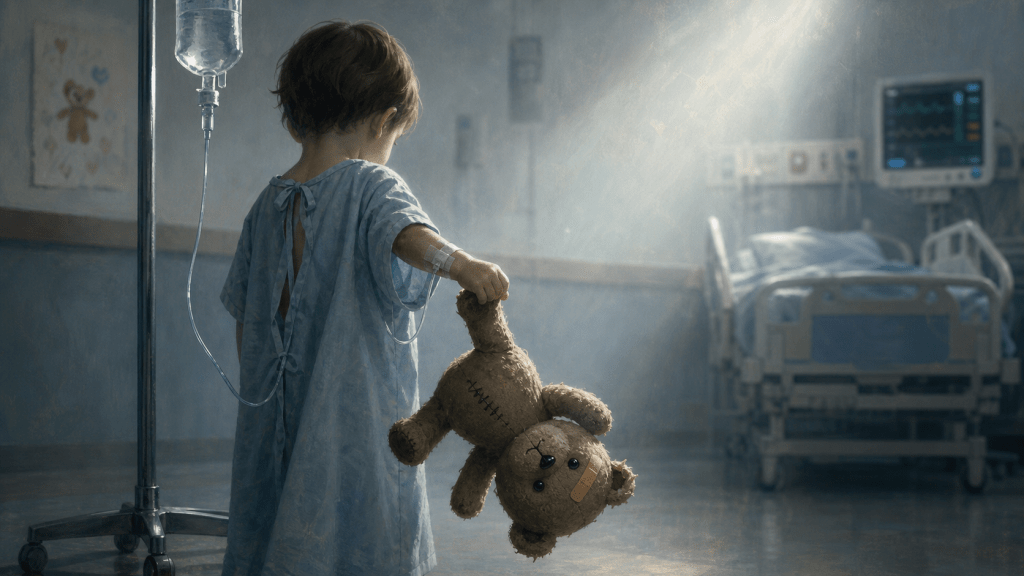
There are faces I will never forget, but the faces of children are the ones I think of most. I have met them in their homes, in crumpled cars and in the back of ambulances, in small emergency rooms, in large trauma centers, in very specialized ICUs. I’ve loaded them onto transport planes and cared for them at altitude. Some of them so small their entire bodies could be held in the palm of my hand, their skin translucent, their eyes still fused shut. Still blind to all around them, a world met only through touch and sound.
Thanks for reading Muddy Water & Mischief! Subscribe for free to receive new posts and support my work.
The trusting eyes of a sick child have always left me somewhat in awe. We enter a hospital room and their eyes meet us. Evaluate us, friend or foe? We speak to them gently. We touch them tenderly. And though we often must perform assessments and procedures that are pain-inducing and frightening, they return to the trust. They need to. It is the only solid ground when their small world gets very scary.
The eyes of parents are different. They project fatigue. Hope. Fear. Strength they never knew they had while dealing with terror they never anticipated. Their eyes are knowing. They have read the studies. They have learned to read the shift in a physician’s posture before the words come. They know the numbers.
The child does not know the numbers. Surprise a gravely ill child with a popsicle or a small plush toy, and the corners of their mouth turn up, and a little hand reaches out. They are always in the moment. They know nothing of their prognosis, their odds of seeing another Christmas, the financial devastation their illness has already begun to carve through their family. They are in the room, with you, right now, and you are someone who brought a popsicle. Santa Claus is still real.
That is what they give us. The trust.
We are supposed to be worthy of it.
After a lifetime in healthcare, I am watching the gutting of medical research with the particular dread of someone who knows what the numbers mean at the bedside. I know what research promises look like from the inside. I have sat with the families who signed those consent forms, grasping at anything that might buy their child more time. So when I read of these cancellations, research stopped mid-study, families left with no transition and no explanation, I know exactly what is being canceled. It isn’t just a budget line.
Three hundred and four clinical trials stopped. Sixty-nine of them focused on children. Money already allocated by Congress, already promised, clawed back. From kids.
The Pediatric Brain Tumor Consortium had operated for twenty-six years conducting trials for children with the cancers that private industry chronically underfunds, because sick children are not a profitable enough market. The National Brain Tumor Society said it plainly: pediatric brain tumors receive less private investment than other childhood cancers. Brain tumors are the leading cause of cancer death in children under fifteen. Federal funding was the backbone holding that research upright. Then it was pulled.
The Diabetes Prevention Program Outcomes Study was thirty years old. It had already proven that lifestyle intervention reduces diabetes risk by fifty-eight percent. Seventeen hundred patients were still being tracked. Then an email arrived. No explanation. Stop all activities immediately.
At Stanford, a study testing whether addressing food insecurity could improve diabetes outcomes in Hispanic children was showing early signs of success. It was canceled. Not by a scientist. By an algorithm scanning grant applications for flagged words. I have a reasonable suspicion which word triggered that review.
Three studies. Three different ways to break a promise to a sick child. One by abandonment. One by email. One by algorithm.
For many of the children enrolled in these trials, the treatment they were receiving does not exist anywhere else. It lives only inside the study protocol. When the funding stops, the medication stops. The child returns to whatever options existed before, which in many cases is precisely why the family signed the consent form in the first place. They had run out of road. The trial was what came after the road ran out.
A specific dollar figure for those sixty-nine pediatric trials does not appear in any publicly available accounting. The Sanders HELP Committee report identified them as part of a broader disruption of three hundred and four clinical trials, but no one in the federal government broke out what the children’s studies were worth separately. No subsequent investigation has produced that number either.
So we cannot tell you how much money was saved.
We can tell you how many children were saved by stopping the research.
Zero.
Less than zero.
Children will die from the withdrawal of this research. Not as a metaphor. Not as a political talking point. As a medical certainty. When you stop a trial for a pediatric brain tumor that has no other treatment pathway, when you cancel a diabetes intervention that was working, when you defund the only coordinated research program studying the cancers that kill more children under fifteen than any other disease, you have not saved money. You have made a decision about which children’s lives are worth the line item. You made that decision by algorithm. You made it without the consent of the family. And you made it without ever having to stand in one of those rooms, holding the gaze of a child with a life threatening illness and wishing you had something more substantial to offer than a popsicle and a teddy bear.
The upside down world we now inhabit was on full display in New Orleans on June 5, 2026. Five physicians were expelled by Louisiana State Troopers and local constables from a convention of their peers for standing outside a meeting room and handing out a journal article. Not a protest sign. Not a petition. A peer-reviewed editorial published in the convention’s own flagship journal, written by the journal’s own editor-in-chief, documenting in the careful language of science exactly what this piece has described.
The American Diabetes Association called the police, though the specific caller has not been revealed. Louisiana State Troopers, working a security detail at the Ernest N. Morial Convention Center, did the rest.
The five physicians were Dr. Steven Kahn, professor of medicine at the University of Washington and editor-in-chief of Diabetes Care, who co-authored the editorial. Dr. Desmond Schatz, former president of the ADA, University of Florida. Dr. Aaron Kelly, pediatrics professor, University of Minnesota. Dr. Justin Ryder of Northwestern University. And Dr. Irl Hirsch, also of the University of Washington. Between them, decades of research, clinical practice, and service to the very organization that just called the cops on them.
They were standing in the hallway outside the room where NIH Director Jay Bhattacharya was scheduled to deliver the keynote address, doing what physicians do at medical conferences. Sharing information with colleagues. The first removal was not gentle. Dr. Aaron Kelly reported being chest-bumped by a law enforcement officer multiple times. A reporter captured it on video. And then, when it was over, when they had been physically pushed out of the building, they went back in. They continued handing out the editorial until a state trooper found them a second time and told Dr. Kahn directly: put your feet inside this convention center again and you will be arrested.
Threatened with arrest for trespassing.
For handing out a journal article.
At a medical conference.
About medicine.
Bhattacharya never made it to the podium. At the last minute, he canceled. Presumably because he realized his address was not going to be well received. So despite the most inconvenient voices in the room already being escorted out, he left anyway. The ADA explained his spur of the moment departure as a last-minute scheduling conflict requiring an in-person meeting with the President. The NIH director, the man who oversees the agency that sent the emails, who heads the office that built the algorithm, who runs the institution that broke faith with those families, could not face a room full of diabetes researchers. He suddenly had somewhere else to be.
The physicians stayed as long as they could. Bhattacharya fled at the first opportunity.
Who’s gonna explain this to the kids?
The editorial referenced throughout this piece, “Misguided Brushes of a Pen Continue to Dismantle and Destroy Biomedical Research in the United States: We Can No Longer Afford Complacency and Fear. We Must All Act Now,” was published April 29, 2026 in Diabetes Care. It is available at https://doi.org/10.2337/dci26-0068. Full text may require journal access. The abstract is free.
Video of the removal, shot by MedPage Today reporter Kristina Fiori, is available at https://www.medpagetoday.com/special-reports/exclusives/114837
 Muddy Water & Mischief
Leave a comment