
Landry Lost the Vote. Now the Schools Pay for It.
ByGovernor Landry is throwing a fit that would earn a schoolchild detention. The voters told him no, so he came after their schools.
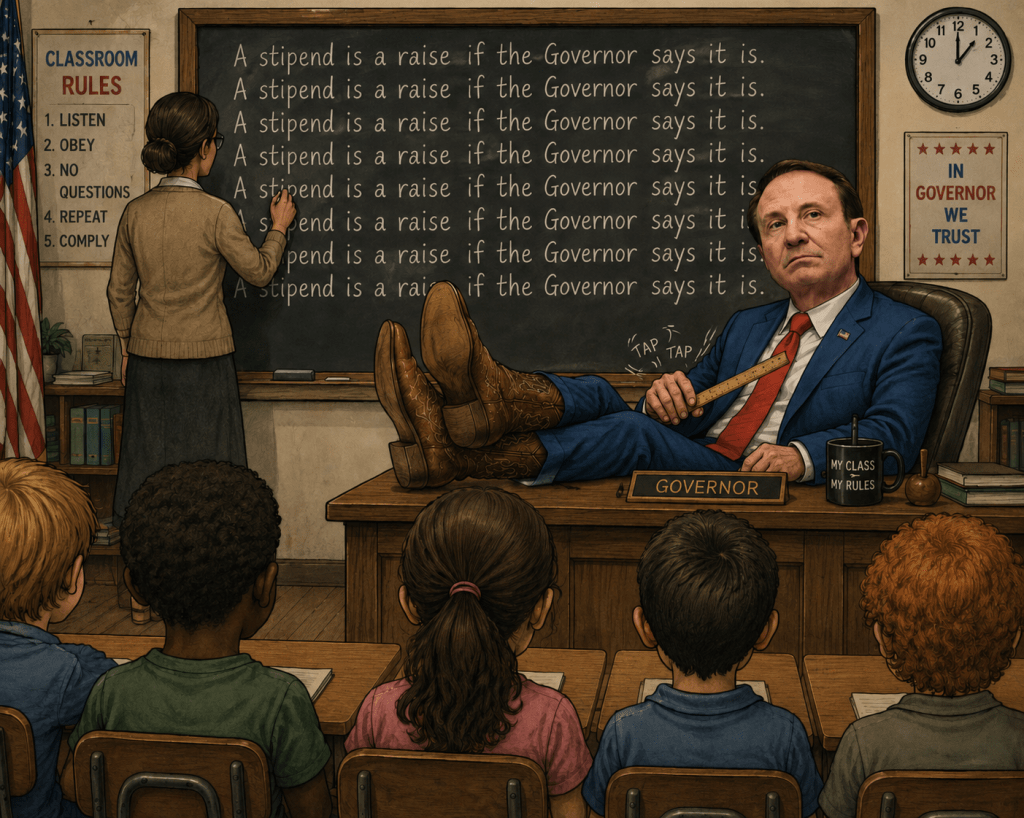
Governor Jeff Landry’s fight over teacher pay and school funding says more about his character and temperament than his budget skills. Faced with a problem he helped create, he hasn’t led, he’s bullied.
Landry and his allies built their latest teacher pay scheme around Amendment 3, a measure that would have drained long-standing education trust funds, used the cash to pay down retirement debt built through years of underfunding and over-promising, and then funneled the savings into permanent raises. Voters were asked to surrender constitutional protections for a modest pay bump that looked a lot like the temporary stipends teachers already receive. The voters refused.
On May 16, 2026, Amendment 3 lost badly, as did the other four amendments on the ballot tied to Landry’s agenda. Legislators had already admitted they had no backup plan if the amendment failed. That left a $200 million hole where a real funding strategy should have been.
What followed I refer to as the fit.
On social media, Landry declared that if teachers didn’t get a permanent raise, “nobody in state government” would get a raise, threatening to freeze pay for tens of thousands of workers until he got what he wanted. But instead of drilling into the state budget to find new money, he ordered $168 million cut from school budgets and redirected into a pot for one‑year stipends.
On June 18, Judge Chip Moore issued a temporary restraining order blocking the plan after plaintiffs argued Landry’s executive order violated the state constitution and exceeded his authority. Eleven days later, he lifted that order. Not because he’d decided the plan was constitutional, but because he agreed to disqualify the plaintiffs’ law firm over a conflict of interest, since the firm also represents the state in another case. The court never reached a ruling on whether Landry has the legal authority to redirect school funding this way.
Regardless, Landry’s message to public employees is clear: your paycheck is a bargaining chip in my political fights.
His executive order carved a chunk out of Minimum Foundation Program operations funding, the money districts use for everyday staffing and services, and repurposed it to cover stipends. Districts’ checks will arrive smaller, and they’re told to “find” the money for mandated stipends inside budgets that have already been cut. When superintendents warned this will mean layoffs and gutted programs, the guv didn’t argue the numbers. He didn’t offer a compromise, he threatened oversight.
At a June news conference, he said, “If the local school systems can’t seem to figure out how to find the money, I’m happy to send the inspector general or legislative auditor in there to take a look at their expenses.” School leaders and advocates have already warned that his funding shift may force personnel cuts and harm programs. He answered by framing their concerns as incompetence. If you can’t swallow the cuts quietly, he’ll send investigators. Bend the knee.
Rural parishes, where the MFP makes up most of the school budget and the local tax base leaves less ability to absorb the loss, will be hit the hardest. WAFB has already reported that Pointe Coupee’s schools would have to make “tough decisions” to absorb a 5% hit to their operating budget.
The redirected funding means stipends now come out of a shrunken operating budget. Some parishes are scrapping permanent raises to afford those stipends. Districts are guessing at murky “exemption” rules that could cost them their share of state money if they move ahead with local pay hikes. Teachers are told to expect another one-time stipend instead of the permanent raise they were promised, and that stipend is being weighed against cuts at the schools where they work. Support staff, bus drivers, cafeteria workers, and paraprofessionals are even more exposed, depending on whether their parish can afford to include them in raises.
Creating financial instability for our educators is not conducive to retaining them at a time when nearby states already provide more lucrative salaries.
On paper, Landry claims he’s standing with teachers. In practice, he’s turned them and support staff into collateral damage. It’s become a “look what you made me do” situation. He talks about what educators “deserve” while making their pay dependent on how much financial pain their districts can absorb. The students are ultimately the biggest losers in the turmoil.
The failure of Amendment 3 was part of a broader rejection of Landry’s style. Organizers urged voters to oppose all five amendments, warning that the package was a top-down rewrite that would rearrange education funds, civil service protections, and local rules without a frank and full discussion of the consequences.
Teachers and education groups voiced deep distrust of raiding education trust funds, arguing that raises should come from honest budget choices, not a shell game that cannibalizes money “at the expense of kids.” Voters have watched Landry cancel elections, threaten state workers, and now strong-arm school systems. Many saw the amendments as another attempt to force his priorities into the constitution instead of persuading people to support them.
His treatment of New Orleans fits the same pattern. In ongoing fights, he has used state authority to override local decisions and punish a city that refuses to play along, meddling in its elections, pushing changes that strip local control, and even threatening local officials with jail through his attorney general. Once you’ve seen that behavior in NOLA, his teacher pay campaign is easier to read. Landry is a governor who treats disagreement not as a problem to solve but as an enemy to crush. It’s not hard to see who he emulates.
Real leadership in a funding crisis would look much different, placing student welfare at the center of decision making. It would start by admitting the revenue damage created by tax cuts, then working with legislators from across the state to identify sustainable revenue and put teacher raises into the regular budget, where trade-offs are visible. It would mean sharing sacrifice, explaining choices, and treating school systems as partners in problem solving, not suspects to be audited.
Landry chose another route. He took a big swing on a constitutional amendment, whiffed it, and then used the tools of the state, executive orders, audit threats, pay freezes to force others to suffer the consequences.
Louisiana ranks 47th in the nation for teacher pay. What Landry now offers isn’t a raise. It’s a one-year stipend carved out of the schools’ own budgets. If the plan is to keep Louisiana’s schools underfunded and its teachers undervalued, it’s going well.
 Muddy Water & Mischief
Leave a comment