
For Meta, Our Failings Are A Feature, Not A Bug
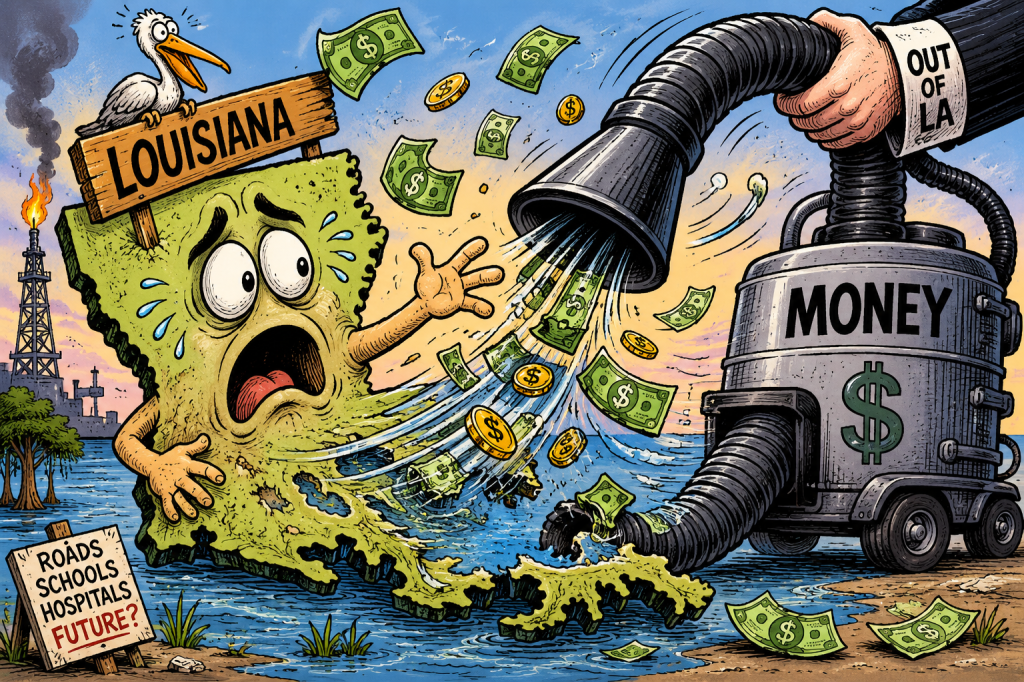
ByHow Louisiana keeps selling itself to industry and calling it progress.
I never met Joyce Piercy. I found her in a Fortune magazine story by Sharon Goldman, published this past March, tucked into the middle of a long piece about what a $27 billion data center looks like when you actually have to live near one. She is 81 years old and has lived in Richland Parish her whole life. Two of her great-grandsons found work at the construction site, temporary jobs, which is the best that can honestly be said about it. The truck traffic has gotten so bad she can no longer safely drive her own road. “I’m just used to plain old country,” she said. I read that sentence and put the article down for a minute. Because I know that plain old country. I was born in Mississippi but have lived most of my life in Louisiana, among people who want the same things. A job that pays. A school worth sending your kids to. Good roads and a house that doesn’t flood. And for as long as I can remember, they have been told the same thing: something big is coming. This time it’s going to be different. Louisiana has been hearing that since before I was born. The industry always comes. The prosperity never quite does.
Here is a number worth sitting with. Between 2015 and 2025, Louisiana attracted ninety billion dollars in capital investment, mostly in petrochemical plants, LNG terminals, and refineries. Ninety billion dollars. In that same decade, job growth in Louisiana was 0.18 percent. The national average was ten percent. The state lost 52,000 residents. Median household income flatlined while the cost of living jumped nineteen percent.
Those numbers come from a New Orleans research organization called The Data Center, a nonpartisan nonprofit that has been tracking Louisiana’s economic trends for years. Here is the part that ought to make us set down our coffee. In 2014, that same organization published a report predicting that the coming wave of industrial investment would produce a “tidal wave” of jobs for Louisiana. They believed it. Everybody believed it. A decade later they published their own reckoning. The tidal wave came, all right. It just wasn’t made of jobs.
So when Governor Jeff Landry stood at a podium in December 2024 alongside Mark Zuckerberg and Entergy’s CEO, shovels in hand, and declared that Louisiana was opening “a new chapter,” I hope you’ll understand my skepticism. We have read this book before. We know how the chapters end.
Here is what this new chapter actually looks like on the ground. Meta’s Hyperion data center, currently under construction in Richland Parish, will be the largest data center on earth when it is finished. It will cover four million square feet on 3,650 acres of what used to be farmland. It will consume more electricity every single day than the entire city of New Orleans. To power it, Entergy Louisiana is building ten new natural gas plants. Ten. Not solar panels, not wind turbines, not some clean energy future we keep hearing about. Gas plants. The same fossil fuel infrastructure Louisiana has been building for a hundred years, now dressed up in a press release about artificial intelligence and the jobs of tomorrow.
Those ten plants will generate more than seven gigawatts of electricity. They will run for thirty to forty-five years. Meta’s contract with Entergy runs fifteen years, and the company has already negotiated a four-year exit option for itself. Read that again. The infrastructure lasts four decades. The company’s legal obligation to stay lasts four years. When Meta decides the economics no longer work, those gas plants will still be here. And somebody will still be paying for them. That somebody is us, if we are Entergy customers in Louisiana. Which, if we live here, we almost certainly are.
Entergy serves 1.1 million customers in this state. The fuel costs for those gas plants will be passed through to every one of us on our monthly bill. The company acknowledged in its own filings that residential bills could rise, and noted that the estimate was incomplete and subject to revision. Upward, one assumes. In July of 2025, one thousand and twenty-five people called Louisiana’s 211 hotline asking for help paying their utility bills. That was one month. That was before the gas plants were built.
So why Louisiana? Why would the biggest technology companies on earth, with the resources to build anywhere, choose to plant their flags in a state that ranks near the bottom of almost every quality of life measure in the country?
Why would they not?
Cheap land. Copious energy deposits. A political class that has been perfecting the art of the sweetheart deal since before the Civil War. And a populace that has been raised, generation after generation, to tolerate getting screwed and calling it progress. Louisiana is not an accident of geography for these companies. Our failings are a feature, not a bug. The same things that made this state attractive to Standard Oil in 1901 make it attractive to Meta in 2026. The resources are different. The arrangement is identical.
But let’s be honest with ourselves. This is not a new story. It doesn’t even have new characters, really. Just new costumes.
Louisiana has been in the business of selling itself to outside industry since before most of our grandparents were born, and the terms of the sale have barely changed. The industry gets the resources, the tax breaks, and the political cooperation. The citizens get the promises, the pollution, and the bill. We’ve been doing this so long it has started to feel like destiny. It is not destiny. It is a choice, and it is a choice that gets made in Baton Rouge, in boardrooms and bars, and occasionally in the back seats of very nice cars, over and over again, by people who will not be the ones living next to or downstream from it.
Consider the Louisiana Lottery Company. In 1868, a former lottery agent named Charles Howard walked into a Reconstruction-era Louisiana legislature that was desperate for money and made them an offer. He would pay the state forty thousand dollars a year for the exclusive right to operate a lottery. The legislature took the deal. What they got, along with the forty thousand, was twenty-five years of systematic bribery that reached into every courthouse, statehouse, and bank in Louisiana. The company’s tentacles, as newspapers of the era described them, extended into every branch of state government. Legislators were on the payroll. Judges were on the payroll. Newspapers that ran the company’s advertising kept their mouths shut. Howard hired Confederate generals P.G.T. Beauregard and Jubal Early to preside over the drawings, because nothing says legitimate enterprise like a couple of men who had recently tried to destroy the United States. When the charter finally expired in 1893, the company had hollowed out Louisiana’s government so thoroughly that lotteries were banned nationwide for the next seventy years. One private enterprise, operating through a compliant legislature, shaped American law for seven decades after it was gone. Charles Howard died rich. Louisiana stayed poor.
Move forward about sixty years and you find Leander Perez, district attorney of Plaquemines Parish from 1924 until his death in 1969. Officially, he was just a DA. In practice, he ran two parishes as his personal property for nearly half a century. He fixed elections. He suppressed Black voters so thoroughly that in 1952, not a single Black person was registered to vote in the entire parish. He subleased state mineral lands to oil companies and pocketed the profits. He authored Louisiana’s segregation laws and fought federal civil rights legislation in court. He strung barbed wire around an abandoned Civil War fort and threatened to jail civil rights workers in it, which tells you something about both his creativity and his judgment. Archbishop Rummel excommunicated him from the Catholic Church in 1962 for obstructing school integration, which is a sentence I enjoy writing because it is completely true.
Leander Perez didn’t just run a racist fiefdom. He ran it in service of Standard Oil, Freeport Sulphur, and every other extractive industry that wanted access to the mineral wealth of south Louisiana. He gave them the political cover, the labor control, and the legal architecture they needed. They gave him and his family decades of royalties and a fortune built on public land. By the time his machine finally collapsed under the weight of its own corruption in the 1980s, the oil companies had long since moved their offices to Houston. Plaquemines Parish is today among the fastest disappearing places on earth, its land subsiding into the Gulf of Mexico, eaten away by decades of pipeline dredging that the industry was never required to remediate. The Perez family got rich. Plaquemines Parish is sinking. Literally.
These are not historical anomalies. They are the operating manual still in use today.
When Huey Long launched his political career he did it by attacking what he called Standard Oil’s “invisible empire.” He was not wrong about the empire. He was also not above building his own. In 1934, while serving as a United States senator, Long and his political associates formed a company called Win or Lose Corporation, which bought up state mineral leases and resold them to oil companies at a tidy profit. The name alone tells you everything you need to know about who was expected to win and who was expected to lose.
But here is where Long diverges from every operator who came before and after him. He delivered. Whatever else you want to say about the Kingfish, and there is plenty, he built roads and bridges across a state that had almost none. He invested in public education and built a free textbook program for Louisiana schoolchildren. He expanded charity hospitals so poor people could actually get medical care. He was a populist tyrant, and the emphasis belongs equally on both words. But he understood something that the people currently standing at podiums with shovels apparently do not: if you are going to extract from the public, you had better give something back, or eventually the public will notice.
Nobody ever did find the deduct box, that legendary super secret cash strongbox into which Long’s state employees were said to contribute a percentage of their salaries as political tribute. It passed into Louisiana folklore, equal parts outrage and admiration, the way things involving Huey tend to do. What replaced it was less colorful but considerably more thorough. These days we call it a non-disclosure agreement, and it is signed by your state senator, your parish president, your school board superintendent, and your lieutenant governor before you are allowed to know that a trillion-dollar company is about to move in next door. Sorry, it’s super secret.
Long was assassinated in 1935. His brother Earl followed him into the governor’s mansion and kept the roads getting built, if not quite with the same manic energy. Louisiana’s oil production peaked in 1970. The industry moved its offices to Houston. The roads Huey built are still here, which is more than you can say for the promises that came after him.
This is the pattern. An outside industry identifies something Louisiana has that it wants: lottery revenue, mineral rights, cheap land, cheap labor, cheap gas. It approaches a legislature that is, to put it generously, receptive to creative arrangements. Legislation is customized. Tax structures are adjusted. Public resources are transferred to private hands. Officials in the vicinity get wealthy. The press release says jobs. The jobs, when they come at all, are temporary. The costs are permanent. And when the industry eventually moves on, as industries do, it leaves behind whatever it has no use for anymore. In Louisiana, that is usually a combination of pollution, poverty, and a fresh set of promises about the next big thing.
The next big thing has a name now. It is called Hyperion. It is built on 3,650 acres of Richland Parish farmland. And it runs on gas.
So how exactly did they pull it off this time? The same way they always do. They wrote the laws first.
In 2024, the Louisiana legislature passed Act 730, a law that grants data centers up to thirty years of sales and use tax rebates on construction, equipment, and cooling systems. Thirty years. It requires a minimum of fifty permanent jobs and two hundred million dollars in investment. It contains no wage standards. No routine public reporting requirements. No automatic penalties if the companies fall short of their promises. Meta alone is projected to extract up to three point six billion dollars in sales tax exemptions in the first decade. The bill passed the Louisiana House eighty-three to four and the Senate thirty-five to nothing. In Louisiana, bipartisan agreement is rare. Giving away the store is apparently one of the things we can all get behind.
That same session produced another gem. House Bill 461 allows parishes and municipalities to declare documents related to economic development negotiations confidential if their release would have a, quote, detrimental effect on business negotiations. In plain English: your elected officials can sign a non-disclosure agreement with a corporation and are then legally prohibited from telling you what was negotiated in your name. Under Governor Landry, at least fifty public officials have signed NDAs with Louisiana Economic Development, including state representatives, state senators, the Lieutenant Governor, mayors, city council members, a sheriff, and a school board superintendent. Not a single elected official signed such an NDA during the entire four years of the previous administration. A woman in Shreveport heard a data center might be coming to her neighborhood. She called every public official she could find to ask about it. Every one of them had signed an NDA. Every one of them told her nothing.
This is the government Jeff Landry has built. Landry, the self-satisfied insider, a man who could strut sitting down, the kind of man you could just as easily picture selling you overpriced crawfish from an uncalibrated scale. So confident in his own standing that when he traveled to Greenland recently, as part of the administration’s quixotic effort to acquire a territory that has no interest in being acquired, local children greeted him by flipping him off. He came home apparently unshaken after inviting them all to an unlimited chocolate chip cookie feed, to which they assumably responded with something like “Skrid med dig.” Which, loosely translated, means who is this idiot. This is the man who stood at a podium next to Mark Zuckerberg, two people with very different bank accounts and surprisingly similar ideas about what Louisiana is for. One of them built a social media empire. The other is giving away your tax dollars to help him power it. You can decide which accomplishment is more impressive.
And then there is State Senator Jay Morris of Monroe, who has been having quite a spring. He helped write the laws that gave Meta its land deal and its tax exemptions. He personally called a utility regulator to make sure the gas plants got approved, and then sold three hundred acres next to the project to Entergy once they were. Ethics experts used the phrase “sustained pattern.” Morris used the phrase “politics as usual.” Both are describing the same thing. In view of his recent actions, one suspects Leander Perez might be the historical figure Morris would most like to have dinner with. Morris also told a Black official to “shut up boy” at a public hearing in May, which in Louisiana in 2026 apparently requires no further explanation or consequence, and he is currently carrying legislation to eliminate one of the state’s two majority-Black congressional districts. If you were building a character to illustrate every theme of this essay, you could not do better than Jay Morris. Louisiana, bless it, just hands you these things.
On April 29th of this year, the United States Supreme Court issued a ruling in a case called Louisiana v. Callais that largely gutted Section 2 of the Voting Rights Act of 1965, the provision that had for sixty years prohibited racial discrimination in voting and redistricting. The conservative majority ruled that Louisiana’s congressional map, which included two majority-Black districts in a state where Black citizens make up roughly a third of the population, was an unconstitutional racial gerrymander. You may want to read that sentence again. Drawing districts to give Black voters representation is now, according to five members of the Supreme Court, unconstitutional. Drawing districts to give Republicans every advantage is fine. The distinction, as Justice Ketanji Brown Jackson noted in dissent, has a strong political undercurrent.
Governor Landry moved faster than a Cajun fiddler’s bow. More than 250,000 Louisiana voters had already cast ballots. Overseas and military voters had been mailed their ballots since April 1st. People had voted. It did not matter. Landry declared an election emergency, stopped the primaries by executive order, and called the legislature into special session to redraw the map. He signed his order with the explanation that, quote, the best way to end race-based discrimination is to stop making decisions based on race. One admires the audacity, if nothing else. The new map eliminates one of the two majority-Black congressional districts. Jay Morris was among those carrying the legislation to make it happen. Landry, Morris, and Perez? Table for three.
There is a through line here worth naming plainly. The same machinery that transfers public resources to private hands also enforces who gets to speak in the room where it happens. The NDA tells the public to shut up. The new congressional map tells Black voters their representation is negotiable. And when a Black official shows up anyway and has the nerve to say something about it, he is told, in the oldest language of Louisiana power, exactly where he stands. It is all one system. It has always been one system. The only thing that changes is which industry is currently being handed the keys, and which voices are being told to shut up while the transaction is completed.
I keep thinking about Joyce Piercy.
She didn’t ask for any of this. She didn’t vote on the gas plants. She didn’t negotiate the tax exemptions. She wasn’t in the room when the NDAs were signed or when the legislature handed Meta three and a half billion dollars in tax relief with one hand while signing away Black voting representation with the other. She was just living her life in the parish where she was born, on a road she could no longer safely drive, watching her plain old country transform into something she didn’t recognize and nobody asked her permission to build.
That is the through line of Louisiana history, from the Louisiana Lottery Company to Leander Perez to the Win or Lose Corporation to Hyperion. The people making the decisions are never the people living with the consequences. The industry gets the mineral rights and the tax exemptions and the exit options. The citizens get the gas plants and the utility bills. The officials in the vicinity get the land deals. And the Joyce Piercys of Louisiana get the truck traffic.
Here is what I know after a lifetime in this state. Louisiana is not poor because it lacks resources. It is one of the most resource-rich places on the continent. It sits at the mouth of the greatest river system in North America. It floats on oil and gas. It has land and water and sun and some of the most resilient and creative people I have ever known. Louisiana is poor because for over a century its resources have been systematically extracted by outside interests operating through a political class that has been, to put it as plainly as I know how, for sale. The price changes. The transaction doesn’t.
The data center boom will not be different. Not because it can’t be. Because nothing in the structure of these deals suggests it will be. Meta can leave in four years. The gas plants stay for forty. Act 730 hands out thirty year tax exemptions with no wage standards and no clawbacks. The NDAs make sure you don’t find out what was promised in your name until it’s too late to object. These are not accidents. They are architecture. Somebody designed this system to work exactly the way it works. The question Louisiana has never quite managed to answer is a simple one. When do we decide that we are worth more than what they are paying for us?
I don’t know the answer. I know that Joyce Piercy is 81 years old and can’t drive her own road. I know that two of her great-grandsons have temporary jobs that will end when the building phase does. I know that the gas plants will still be running long after everyone who cut the ribbon at that December groundbreaking has moved on to their next deal. And I know that somewhere in Richland Parish, on a road full of trucks carrying equipment for the largest data center on earth, an 81 year old woman is looking out her window at a Louisiana she didn’t choose, built by people she didn’t elect, for purposes that have nothing to do with her.
Plain old country.
It was worth more than this.
Joyce Piercy just wants the five pounds of crawfish she paid for.


Leave a Reply